Expert surgical flat and low-slope roof repair for residential rear porches, modern additions, sunrooms, and commercial properties across Raleigh and Wake County. From hot-air welded TPO patches and EPDM rubber seam resealing to severe ponding water drainage correction and elastomeric fluid-applied coatings—we eliminate flat roof leaks without costly premature tear-offs.
Common Failure: Applying over damp substrates or thin dry film thickness (DFT).
Surgical Fix
96% high-solids silicone restorative coatings with stitch-bonded polyester mesh at scuppers.
Building Code Diagnostic
Ponding Water: The Silent Killer of Raleigh Flat Roofs
The 48-Hour Building Code Rule
Per the National Roofing Contractors Association (NRCA) and NC Residential Building Code: Any standing water remaining on a low-slope roof 48 hours after rain ends is classified as ponding water. Standing ponds void manufacturer warranties and accelerate material degradation exponentially.
Why Raleigh roofs fail: Severe Piedmont summer thunderstorms drop 2+ inches of rainfall within an hour. Clogged drainage scuppers from heavy Loblolly pine straw combined with natural rafter deflection on residential patio additions trap deep water reserves.
Stage 01
Solar Magnification
The puddle acts as a convex lens, intensifying UV rays and baking the membrane to premature brittleness.
At 5.2 lbs per sq ft per inch, trapped water deflects wood decking, pulling membrane fasteners through insulation.
Engineered Corrections
How We Correct Flat Roof Drainage
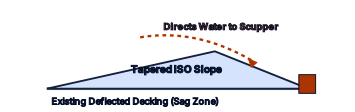
Cross-section: Tapered Polyiso cricket diverting water from dead-level bays.
Tapered ISO Crickets
Adding custom sloping insulation panels to permanently redirect runoff into outlets.
Scupper Enlargement & Sumps
Upgrading pinched 2-inch drain tubes to 4-inch heavy commercial box scuppers.
High-Solids Ponding Silicone
Chemically inert elastomeric polymers that never soften or wash away under permanent submersion.
Objective Engineering Guidance
Repair vs. Silicone Coating vs. Full Replacement
Do not let an aggressive sales crew sell you an expensive $14,000 complete tear-off if your insulation is dry and your substrate is structurally sound.
Decision Factor
Surgical Spot Repair
Fluid-Applied Silicone
Full Replacement
Best For
Isolated punctures, pipe boot splits, single seam separation (<10% area)
Sound deck with aged surface, widespread micro-fissures, or small ponding (10–40% aging)
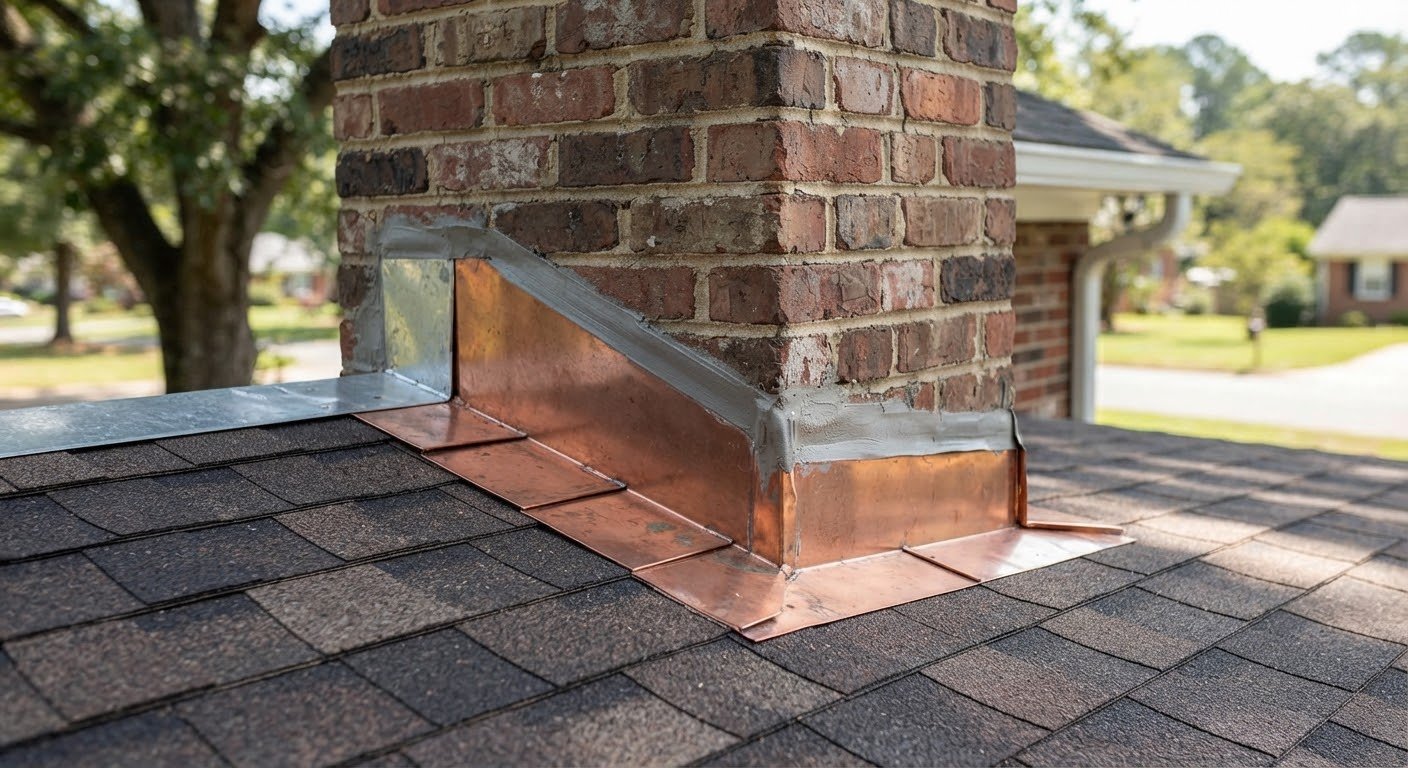
The #1 flat roof emergency in Wake County occurs where a steep architectural shingle roof slopes downward and meets a flat or low-slope porch addition (under 2:12 pitch).
Code Violation Warning: Pitch Below 2:12
Installing standard asphalt shingles below 2:12 pitch directly violates NC Residential Building Code Chapter 9. Capillary back-siphonage draws rainwater up under shingle keyways during heavy Carolina downpours.
1
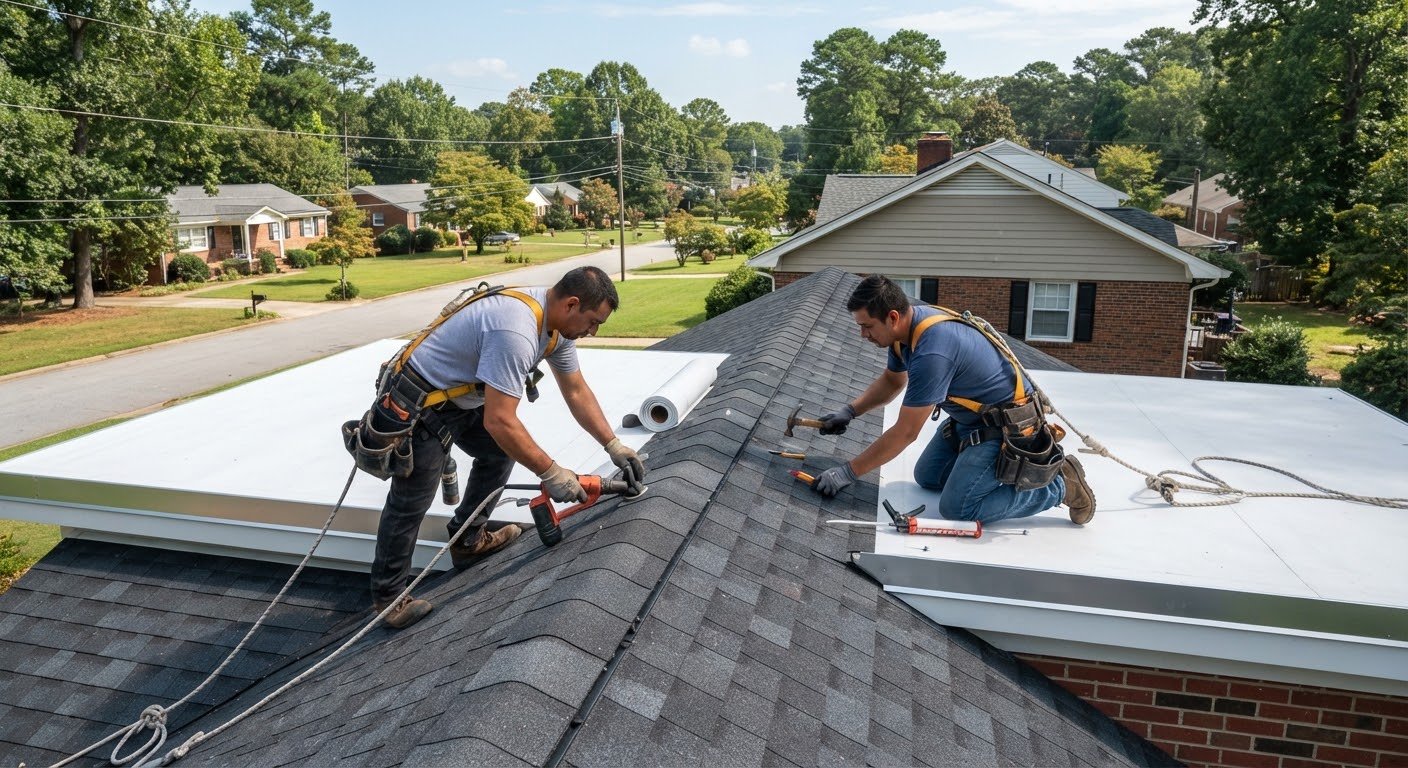
Shingle De-Nailing & Clean Removal
We carefully remove the bottom 2 to 3 courses of existing steep-slope shingles to expose clean underlayment.
2
Grace Ice & Water Shield Transition
High-temp elastomeric self-adhering membrane is carried a full 24 inches up the transition pitch.
3
Membrane Headlap Interlock
We lock TPO or SBS bitumen 18 inches beneath the steep shingles with continuous termination bar flashing.
4
Drip Edge & Gutter Integration
24-gauge custom brake-formed drip edge is mechanically fixed and sealed straight into the aluminum gutter trough.
Porch Transition Project
Lochmere Neighborhood, Cary NC
Zero Leak Tested
Re-flashed low-slope Florida room tie-in that had rotted the fascia board due to original builder missing the transition membrane seal.
Wind Uplift Tested
Fastened to 110 MPH Piedmont coastal storm gusts.
Water Head Flood Tested
Simulated 4-hour monsoon flood test prior to signoff.
Transparent Wake County Pricing
Flat Roof Repair Investment Benchmarks
We provide upfront, fixed-scope proposals without hidden charges or mid-job price gouging.
Tier 01
Surgical Seam or Puncture Repair
$350
– $650
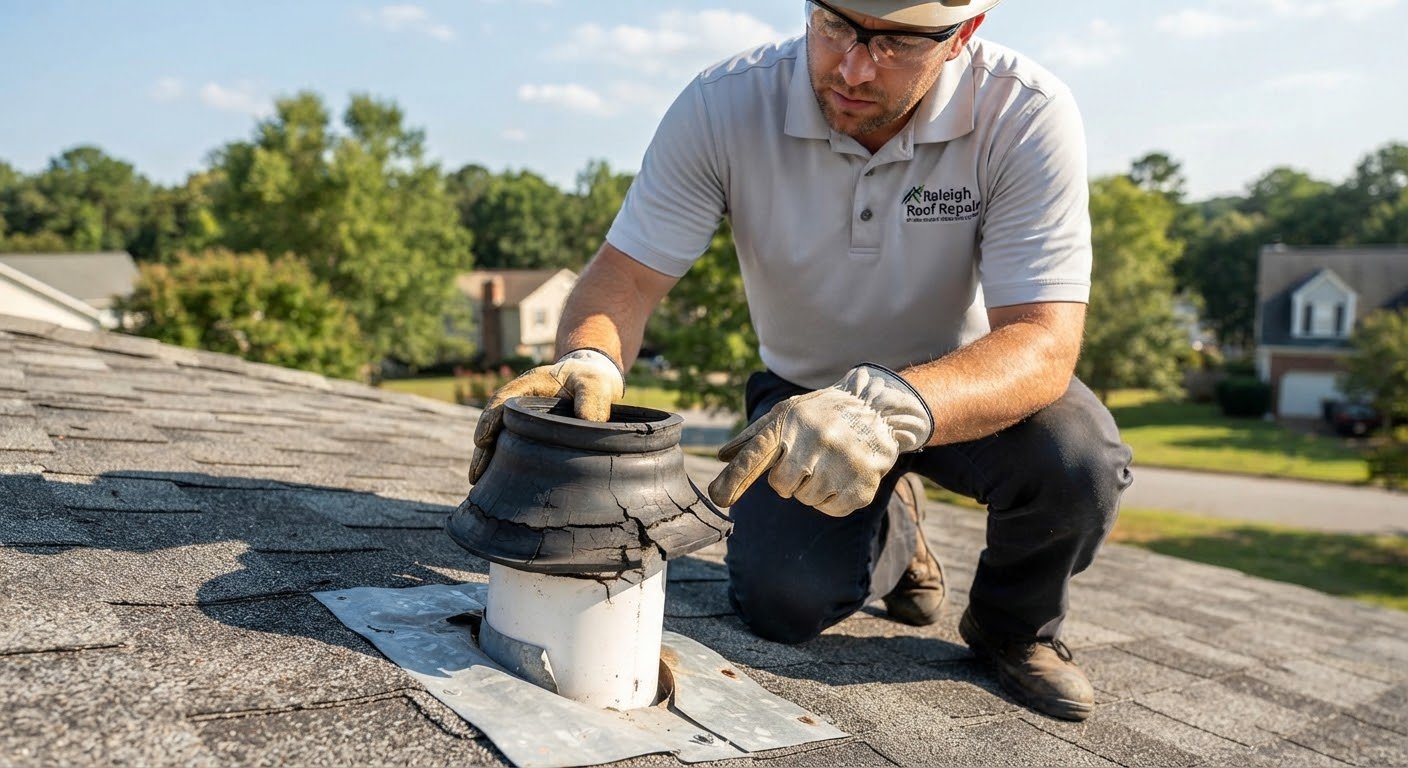
Best for isolated mechanical branch holes, split pipe collars, or detached lap seams under 10 sq ft.
Fair Pricing Guarantee: Every proposal includes an infrared non-invasive perimeter moisture scan, commercial-grade polymer adhesives, magnetic nail sweep of your driveway and patio, and our direct Written Leak-Free Workmanship Warranty.
Frequently Asked Questions
Raleigh Flat Roof Repair FAQs
Straight answers from licensed commercial and residential low-slope specialists.
Can you patch a flat roof instead of replacing it?
Yes, absolutely. As long as the underlying polyisocyanurate (ISO) insulation or plywood roof deck has not sustained widespread water saturation and rot, surgical patching is the recommended industry approach. Using hot-air welding on TPO or cured primer tapes on EPDM, we can isolate and repair punctures or open seams for a fraction of the cost of a full roof tear-off.
Why does water pool on my flat roof and how long can it stay before it causes damage?
Water pools because flat roofs are actually low-slope roofs designed with a minimal 1/4-inch per foot fall. When rafters sag or drainage scuppers become clogged by pine needles, water accumulates. According to the National Roofing Contractors Association (NRCA) and North Carolina Building Code, water remaining 48 hours after rain ceases is classified as "ponding water" and will accelerate UV degradation and dissolve adhesive seams if uncorrected.
Can I put regular shingles on my flat or low-slope porch roof?
No. Standard fiberglass-asphalt architectural shingles require gravity to shed moisture. Installing shingles on any roof pitch under 2:12 (less than 2 inches of vertical rise per 12 inches of horizontal run) is an explicit violation of the NC Residential Building Code. Shingles installed on flat pitches cause capillary action that sucks water backward underneath the laps, rotting decking within 2 to 4 years.
What is the difference between TPO and EPDM rubber roofing?
TPO (Thermoplastic Polyolefin) is a white, reflective single-ply membrane that utilizes 1,000°F hot-air welded seams that fuse chemically stronger than the sheet itself, reflecting 78%+ of solar heat. EPDM is a durable synthetic black vulcanized rubber sheet joined with chemical adhesive tapes. EPDM offers superior elongation and hail impact resistance, while TPO is preferred in North Carolina for thermal cooling efficiency.
How do you find where a flat roof leak is actually entering when water drips several feet away?
Flat roof leaks rarely drip straight down; water enters a pinhole or failed seam, travels across insulation boards or decking flutes, and emerges far from the puncture. We employ electronic non-invasive capacitance moisture meters and infrared thermal imaging cameras during evening cooling cycles to trace subsurface moisture pathways directly to the originating puncture.
Can a silicone roof coating really seal an old leaking flat roof without tearing it off?
Yes. High-solids 96% silicone coatings cure into an impervious, seamless rubber blanket over existing TPO, EPDM, or Modified Bitumen systems. Because silicone is non-organic and chemically inert, standing ponding water cannot break it down. When preceded by surface washing, seam reinforcement mesh, and adhesion priming, fluid-applied restoration adds 10 to 15 years of warranted life at less than half the cost of replacement.
Emergency Dispatch Available 24/7
Flat Roof Ponding Water or Leaking Seams?
Speak directly with an NC-licensed low-slope roofing technician. We provide on-site diagnostics, thermal leak tracing, and clear, written repair estimates across Wake County.